News
Node Spotlight: IndOBIS, advancing marine biodiversity data coordination across the Indian Ocean
29 April 2026
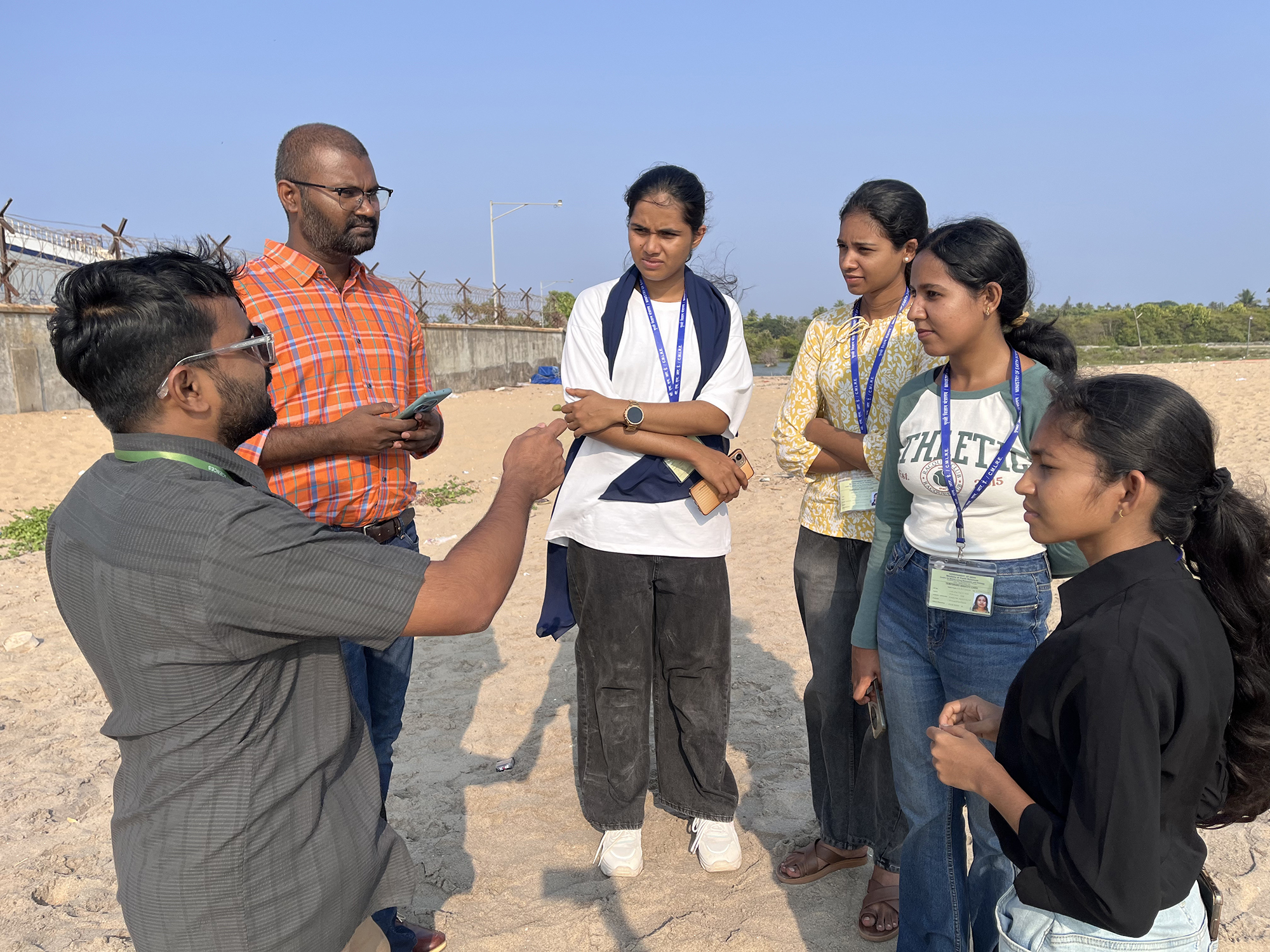
Dr Hashim Manjebrayakath, IndOBIS Node Manager (left, grey shirt), and Johnny Konjarla, IndOBIS Data Manager (second from left, orange shirt), lead a field demonstration of the OceanEyes citizen science app during student outreach activities in coastal India, in March 2026. Photo: CMLRE
IndOBIS, the OBIS Node for the Indian Ocean, coordinates marine biodiversity data from across the entire basin, the third-largest ocean after the Pacific and the Atlantic, holding almost 20% of water on Earth’s surface. The Indian Ocean is home to ecologically significant coral reef systems and some of the most biologically rich and diverse waters in the world. We spoke with Dr Hashim Manjebrayakath, IndOBIS Node Manager, and Johnny Konjarla, IndOBIS Data Manager, to learn more about how the Node’s structure and operations, its role in the national marine data landscape, its engagement with researchers and citizens, and its place within the wider OBIS Community.
OBIS: Dear Hashim and Johnny, it’s a pleasure to have this talk with you! Could you introduce us to IndOBIS?
Dr Hashim Manjebrayakath: We are delighted to be here! IndOBIS is the OBIS Node for the Indian Ocean, hosted at the Center for Marine Living Resources and Ecology (CMLRE) under the Ministry of Earth Sciences, which is our funder. The Node office and our data infrastructure are located in Kochi, Kerala, on the southwestern coast of India. We are currently two staff members: Johnny, who is the IndOBIS data manager and has been at that post since 2017, and I, the Node manager, directly attached to the Ministry of Earth Sciences. IndOBIS’s role is mainly to aggregate data from a wide range of providers, with a strong focus on ministry-funded projects. We standardize these datasets and publish them into OBIS, to make that data globally accessible.
Johnny Konjarla: Maybe I can add a bit of historical context to complete that picture! Back in the early 2000’s, IndOBIS started as part of the Census of Marine Life. After the Intergovernmental Oceanographic Commission (IOC) of UNESCO integrated OBIS, our Node moved to CMLRE, directly translating a shift in India’s strategic priorities in marine management and conservation. Then, in 2022, building on this foundation, IndOBIS, like most OBIS nodes, officially became an Associate Data Unit (ADU) under the International Oceanographic Data and Information Exchange (IODE) program of IOC. We collaborate closely with India’s IODE National Oceanographic Data Center (NODC), hosted at the Indian National Center for Ocean Information Services (INCOIS), which serves as India’s official repository for national oceanographic data. Both CMLRE and INCOIS operate under the Ministry of Earth Sciences.
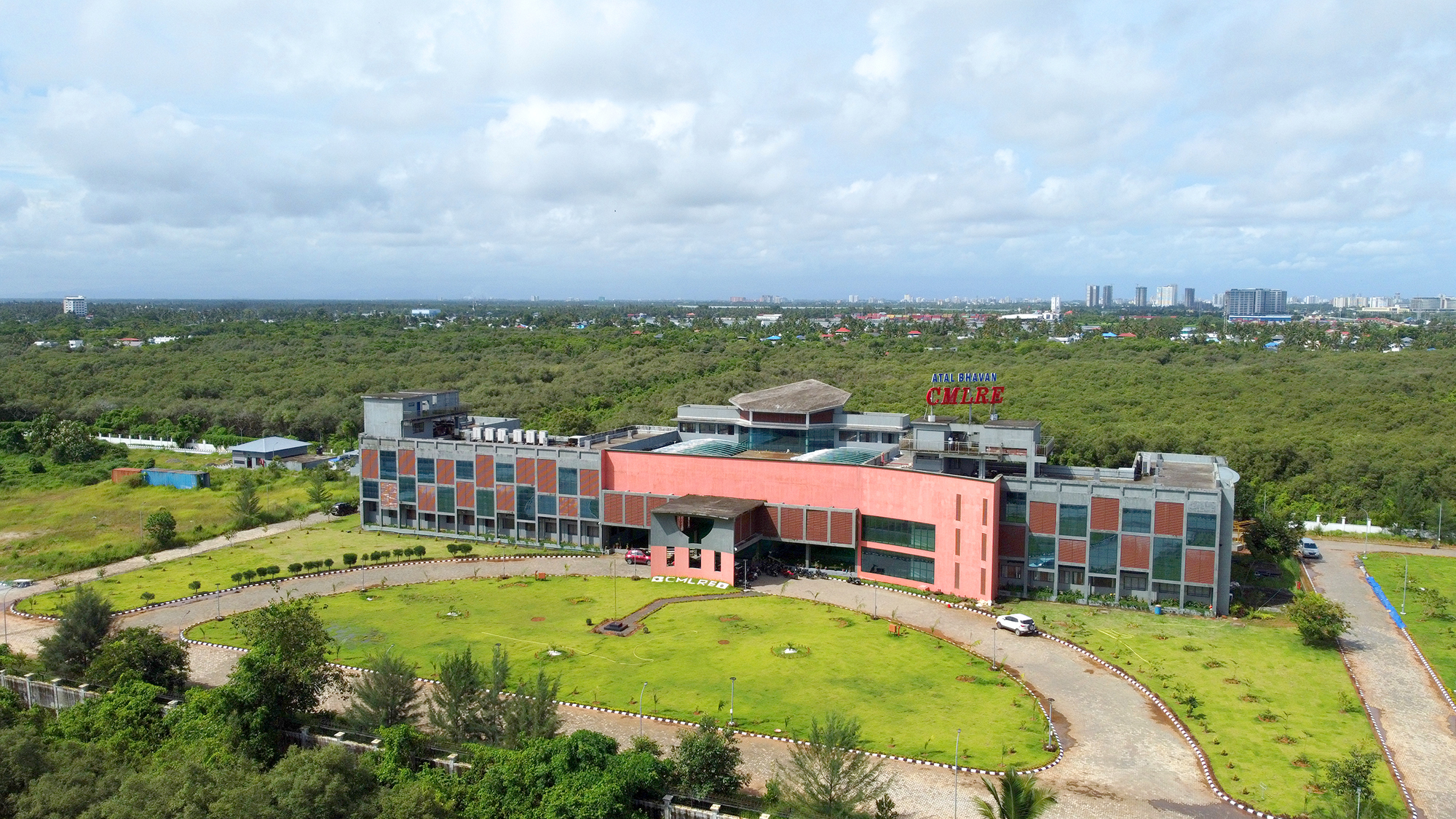
Aerial view of the Centre for Marine Living Resources and Ecology (CMLRE), Kochi, India, host institution of IndOBIS and a national centre for marine biodiversity research.
Photo: CMLRE
What drove the creation of IndOBIS?
Dr Hashim Manjebrayakath: India is a very large ocean-facing country, with a coastline of over 11,000 km and a 2.3 million square kilometers of Exclusive Economic Zone (EEZ). Each year, India runs hundreds of marine-related scientific projects across different ministries. Before the creation of IndOBIS, and especially in the pre-digital era, this resulted in major data silos, with marine information being scattered across many institutions and locked there. One major driver to create IndOBIS was to completely reorganize the national marine data landscape and streamline the many data flows into a clear pathway, under the common objective to make that data accessible to all.
Johnny Konjarla: A coordinated and well-structured marine biodiversity data landscape is fundamental for India. It reinforces our country’s capacity to contribute and play a significant role in global frameworks like the Convention on Biological Diversity and the BBNJ Agreement. It supports national data needs for ocean conservation and management, as well as the sustainable use of marine resources to sustain the development of our blue economy.
How does IndOBIS sit within the Indian marine research ecosystem today?
Dr Hashim Manjebrayakath: IndOBIS operates in a complex ecosystem, with numerous and very diverse sources producing data on marine life. Beyond the state-funded projects we already talked about, universities and research institutions also produce marine biodiversity data. We also try to aggregate local and traditional knowledge about marine species occurrences. Our efforts focus on getting all that data published globally into OBIS.
What are the biggest challenges regarding the marine biodiversity data landscape in India today?
Dr Hashim Manjebrayakath: There are many ongoing challenges. The country’s size, its long coastline, and the huge number of institutions involved in collecting marine biodiversity data make coordination a perpetual challenge. India aims to become a regional driver for marine biodiversity issues. To take up this role, we need to maintain our position at the forefront of marine data-related issues, from integrating emerging data types and including local and traditional knowledge into global data platforms to promoting the ownership of data providers, especially in the case of local and traditional knowledge. We are deploying efforts to aggregate this crucial source of biodiversity information that enriches scientific observations. A good example is the mudbank phenomenon that can be observed in Kerala, where specific coastal areas attract large fish aggregations at very particular times of year. This is localized ecological knowledge with a clear scientific basis, but it currently sits outside data collection pipelines. Capturing this kind of knowledge, in all its diversity, and making it interoperable with global standards, is one of our key challenges.
Johnny Konjarla: We need both technical solutions and a cultural shift towards open and standardized data practices. We need to strengthen our efforts in reducing data fragmentation at local and national levels, and increasing the adoption of recognized data standards by data providers. Additionally, some providers still show reluctance to share their data, and, in some cases, will only do so based on personal relationships rather than national efforts. We need to maintain our efforts in explaining the benefits of data sharing, especially addressing the specific ownership and recognition issues.
.JPG)
FORV Sagar Sampada, a multidisciplinary fisheries and oceanographic research vessel managed by CMLRE, supports marine biodiversity surveys and oceanographic research across the Indian Ocean.
Photo: CMLRE
How do you incentivize local data holders, whether they are researchers or communities, to publish their data through IndOBIS?
Dr Hashim Manjebrayakath: Initially, we worked primarily with projects that were funded by the Ministry of Earth Science. We required systematic data sharing and publication to OBIS through IndOBIS. That initial engagement served as our starting point for broader collaboration with the research community. We used it as a positive example to get more contributors on board. We organized dozens of workshops across India focusing on the benefits of data sharing. One of the key points was to explain that publishing to OBIS maintains data ownership while increasing recognition for data providers and their hosting institutions.
There is also a more formal channel that brings data to IndOBIS. When researchers publish a new species or a new record, they are required to deposit a type specimen, such as a paratype or a holotype, at a nationally or internationally recognized referral center, like CMLRE. Many researchers now voluntarily deposit their physical samples at our referral center and share their associated data through IndOBIS. It is almost a natural pairing: the specimens stay with us, and the associated data becomes globally accessible through OBIS.
Johnny Konjarla: Because of the size of our country and the diversity of the potential data providers, we had to deploy several approaches. We organized capacity-building workshops online and in person, but we also participated in conferences and outreach events across the country. These efforts were crucial to create trust bonds with entire communities and increase the visibility of IndOBIS. All of that engagement increased contributions: IndOBIS published 1,14,000 records, with 10,000 added in the last three years.
We mainly position ourselves as facilitators, supporting researchers to mobilize and publish their data on OBIS. We have developed dedicated, streamlined technical processes to help them format and curate their data to make it fit for publication. We also realized that rather than imposing strict requirements, focusing on showing the value of data sharing yielded better results: We encourage researchers to publish their scientific results first and then share their datasets with us afterward. And we are now concentrating our efforts on data from emerging observation techniques, such as environmental DNA, which brings its own challenges.
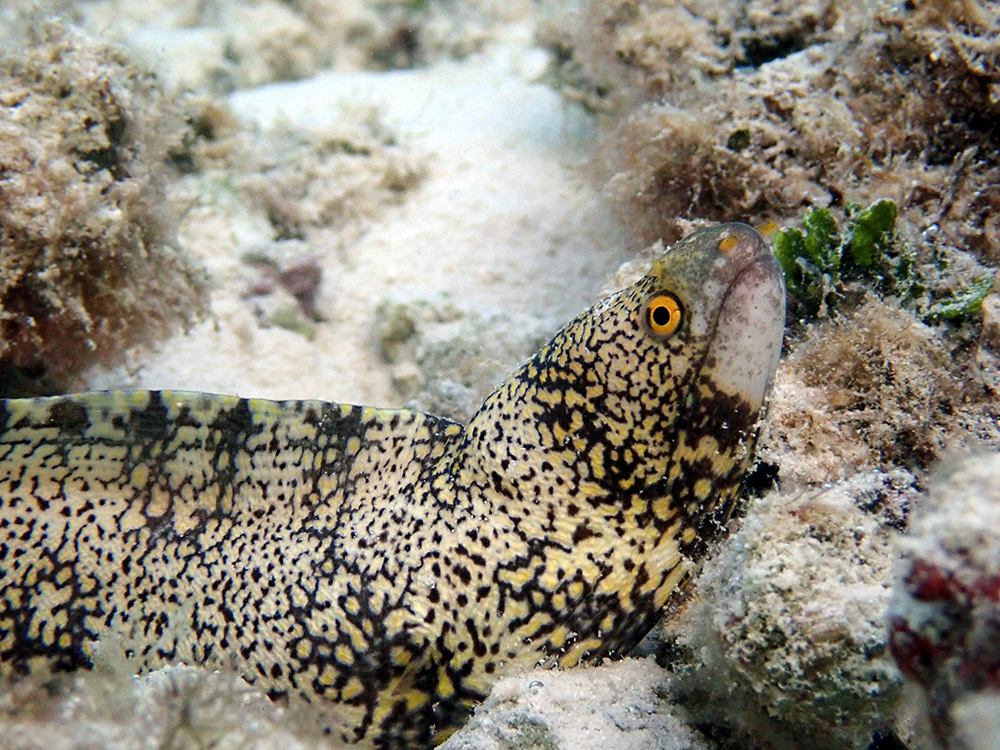
The snowflake moray eel, Echidna nebulosa, documented during underwater biodiversity surveys in Lakshadweep Islands during 2018.
Photo: CMLRE
Do you still have local communities in India you have not yet connected with?
Dr Hashim Manjebrayakath: Thanks to our efforts, we covered a lot of the public scientific communities. We are now focusing on Non-Governmental Organizations working in the marine field in India, and on data generated through citizen science initiatives. This is part of our Node’s priorities. We recently organized a student workshop with theoretical sessions and field work focusing on OceanEyes, an Indian app gathering marine life observations from citizens.
Could you tell us more about Ocean Eyes and how IndOBIS is involved?
Johnny Konjarla: Absolutely! Ocean Eyes is a citizen science mobile application we developed to document marine biodiversity across India. The idea originated with our former node manager, Saravanane Narayanane. Our team was closely involved in conceptualizing and designing the application. The principle is very straightforward: Users record observations through photos or videos, and add metadata such as location or habitat. A team of taxonomic experts curates all the collected data before publishing it to OBIS.
We just published a paper about the app and what it means for marine life observations in India. Our idea is to enable anyone in India to contribute marine life observations through a simple and accessible platform. Given the scale and diversity of the country, we aim to make the application more inclusive and user-friendly. This includes plans to integrate AI-assisted species identification and support for additional languages to broaden participation. Citizen science is extremely important for the vast country that is India. Traditional marine surveys alone cannot cover all our scientific needs. Educating and engaging citizens about the need for ocean biodiversity observations will eventually enable more data publication. These efforts also give people a sense of ownership and involvement, while raising awareness about marine conservation.
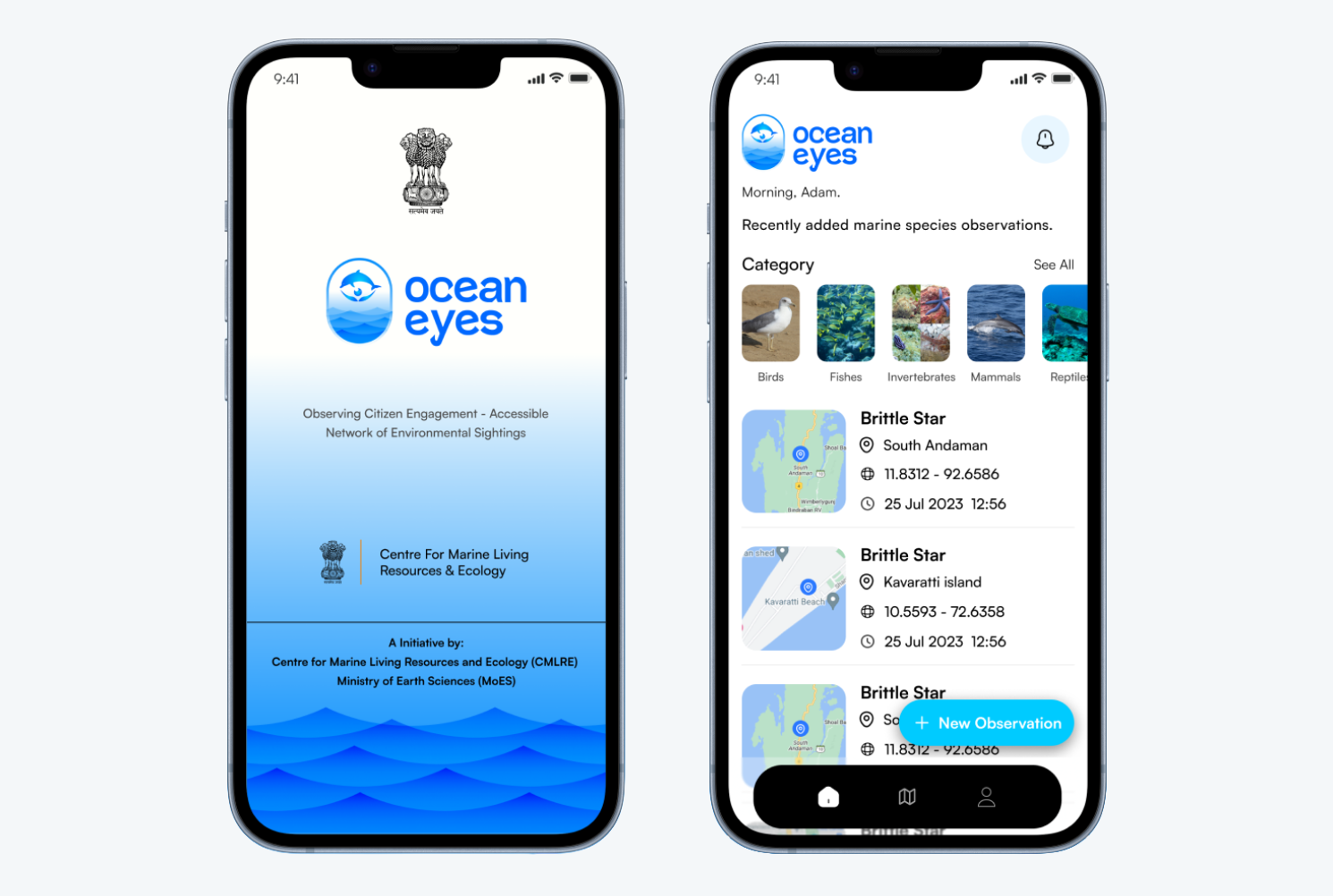
Screenshots of the landing page and home page of the OceanEyes app.
Image: OceanEyes
Let’s shift away from the citizens’ perspective to focus on authorities and decision-makers: how was IndOBIS data used to support Indian marine policy or reporting?
Dr Hashim Manjebrayakath: IndOBIS data is directly used to answer parliamentary questions. Members of the Parliament send us explicit questions related to marine life, conservation, or management, and IndOBIS is bound to respond. This places our Node firmly within India’s policy-making process, as a direct source of national decisions.
IndOBIS data also feeds into the Indian Deep Ocean Mission, a major national program with a total value of over US$450 million. One of its core sections is dedicated specifically to marine biodiversity data generation, and IndOBIS contributes directly to it. And of course, we are also actively involved in processes related to the BBNJ.
Is there a dataset or project within IndOBIS that you are particularly proud of?
Dr Hashim Manjebrayakath: I’m proud of a collective effort: the data mobilization that we achieved, with contributions from many different sources across India. It is not only the work of the IndOBIS Node Manager or Data Manager. It’s a national effort, uniting communities, institutions, and regions.
Johnny Konjarla: From my perspective as Data Manager, there are a few datasets standing out. My first dataset, which I standardized from our in-house program, the Resource Exploration and Inventorisation System, and published into OBIS, was an important milestone for me. Then, a DNA-derived dataset of Kogia breviceps. It consists of only a single record, but it has significant value because I felt I could handle diverse and emerging data types, such as molecular and eDNA data, within the IndOBIS framework. Again, a huge milestone. Finally, I would like to highlight the Ocean Eyes project as something I am very proud of.
Do you collaborate with other OBIS nodes, and what does being part of the OBIS community mean to you?
Johnny Konjarla: Through the different OBIS coordination groups, we have had the opportunity to interact with many nodes. We have discussed common challenges and shared best practices. Being part of the OBIS community is invaluable: it allows for this exchange and helps us improve our work.
Dr Hashim Manjebrayakath: We would very much like to strengthen collaboration, especially within the Indian Ocean region. We are ready to support other Nodes, whether technically or to help address training needs. We are keen to develop more direct, Node-to-Node collaborations. We also consider how IndOBIS could act as a Node for countries of the Indian Ocean Rim Association, drastically increasing local data contributions from the region to the world.
What other plans are on IndOBIS’s horizon?
Dr Hashim Manjebrayakath: We are preparing our next development stage. In India, ministry-led initiatives such as IndOBIS undergo funding and planning cycles that are five years long. For the next cycle, which starts in September 2026, we have set new ambitions for IndOBIS. We aim to better align with national marine priorities by expanding our activities and strengthening data mobilization across the country. To achieve that, we will increase our task force and capacity. Expanding the team is a priority!
Last question: If you had a magic wand and could change one thing about marine biodiversity data in India, what would it be?
Dr Hashim Manjebrayakath: I would make it so that every single piece of biodiversity data generated in India would be known to IndOBIS. That would be fantastic!
Johnny Konjarla: I would systematically include data sharing as part of the requirement for research funding. Every project would include a clear data management plan from the proposal stage, specifying how and when data will be shared. I would also make sure that funding agencies ensure accountability by linking data submission to project outcomes. All of this for the common good, to significantly improve data accessibility, reuse, and overall impact. ◼️